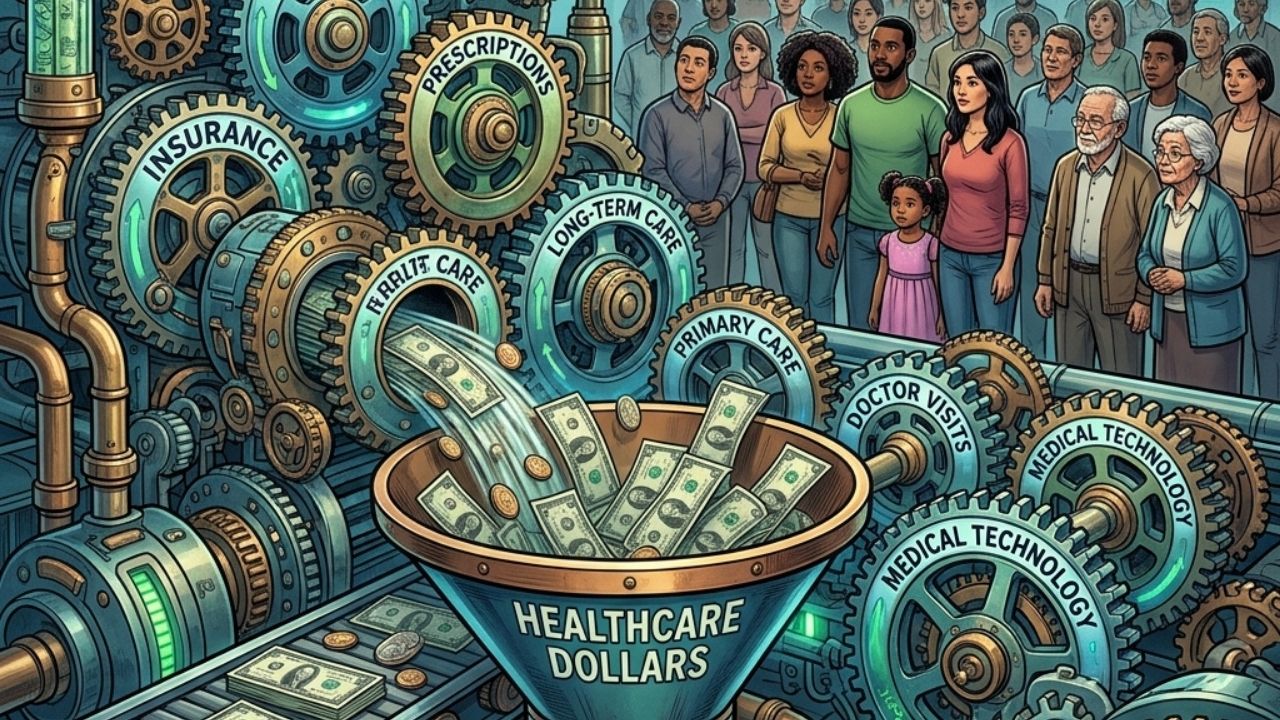
The United States spends more on healthcare than any other nation—about $4.9 trillion in 2023, or roughly $14,570 per person, according to the Centers for Medicare & Medicaid Services (CMS). The largest slices go to hospital care (around 30%), physician and clinical services (around 20%), and prescription drugs (around 9%), with administrative costs and insurance overhead consuming a significant share on top of that.
Every year, healthcare eats up a bigger portion of the average American family’s budget. Premiums climb, deductibles grow, and surprise bills land in mailboxes with numbers that don’t seem to match the care received. Yet most people have little idea where all that money actually goes.
Understanding the flow of healthcare dollars isn’t just an academic exercise. It affects the choices you make—whether to visit an ER or an urgent care clinic, whether to ask for a generic drug, and how to plan for the costs of aging. Knowledge here translates directly into savings and better decisions.
This post breaks down the U.S. healthcare system by following the money. We’ll look at national spending trends, then dig into hospitals, prescription drugs, insurance overhead, primary care, medical devices, and the growing costs of long-term care. By the end, you’ll have a clearer picture of what your medical dollars pay for—and where the system’s biggest pressure points lie.
How much does the U.S. spend on healthcare each year?
National health spending reached approximately $4.9 trillion in 2023, according to CMS data. That figure represents about 17.6% of the country’s gross domestic product—a larger share than any other developed nation devotes to healthcare.
To put it in perspective, the United States spends nearly twice as much per person as the average among wealthy countries in the Organisation for Economic Co-operation and Development (OECD). Yet by many measures—life expectancy, infant mortality, chronic disease rates—American outcomes lag behind those of nations that spend far less.
Where does the average healthcare dollar go?
Broadly, national spending breaks down like this, based on CMS National Health Expenditure figures:
- Hospital care: roughly 30%
- Physician and clinical services: roughly 20%
- Prescription drugs (retail): roughly 9%
- Nursing care, home health, and long-term care: roughly 9% combined
- Administration and insurance overhead: roughly 7-8%
- Dental, other professional services, medical equipment, public health, and investment: the remainder
These proportions have stayed relatively stable over the past decade, though prescription drug spending and administrative costs have both grown faster than inflation in several recent years.
Why does the U.S. spend more than other countries?
The gap isn’t mainly because Americans use more healthcare. Research from the Commonwealth Fund and others points to higher prices as the primary driver. A hospital stay, a common surgery, or a brand-name drug simply costs more in the U.S. than in Germany, Canada, or Japan. Add a fragmented insurance system with high administrative overhead, and the spending gap widens further.
Where do hospital and clinical costs go?
Hospital care is the single biggest category of U.S. healthcare spending. Roughly a third of every healthcare dollar flows to inpatient and outpatient hospital services combined.
What drives inpatient and outpatient costs?
Inpatient care—when you’re admitted and stay overnight—covers room charges, nursing, medications administered during your stay, and the use of hospital facilities. Outpatient care, which includes same-day surgeries, diagnostic tests, and clinic visits, has grown steadily as medical advances let more procedures happen without an overnight stay.
Prices for the same service can vary dramatically between hospitals, even in the same city. A routine MRI might cost a few hundred dollars at one facility and several thousand at another, depending on negotiated insurance rates and the hospital’s pricing structure.
Why is the emergency room so expensive?
Emergency room visits are among the costliest ways to receive care. A single ER visit can run into the thousands, even for issues that a primary care doctor or urgent care clinic could handle for a fraction of the price. The high cost reflects the ER’s round-the-clock staffing, specialized equipment, and legal obligation to treat everyone regardless of ability to pay.
For non-life-threatening problems, urgent care centers and telehealth visits often deliver similar care at far lower cost. Choosing the right setting is one of the most direct ways patients can control their own spending.
How much do hospitals spend on administration?
A meaningful portion of hospital budgets goes to administrative overhead—billing, coding, insurance negotiations, and regulatory compliance. Studies have estimated that administrative activities account for roughly a quarter of U.S. hospital spending, a higher share than in most other countries. Every insurer requires different paperwork, and that complexity adds cost at every step.
Why are prescription drugs so expensive in America?
Prescription drug spending accounts for roughly 9% of retail national health expenditures, but that figure understates the true burden because it excludes drugs administered in hospitals and clinics. For many families, medication is the most visible and painful out-of-pocket cost.
How is drug pricing determined?
Unlike most developed countries, the U.S. does not set national price controls on most medications. Prices emerge from negotiations among drug manufacturers, pharmacy benefit managers (PBMs), insurers, and pharmacies. This layered system makes pricing opaque, and the list price you see rarely matches what any single party actually pays.
The Inflation Reduction Act, signed in 2022, began allowing Medicare to negotiate prices on a limited set of high-cost drugs—a significant shift for a program that had long been barred from doing so.
Should you choose generic or brand-name drugs?
Generic drugs contain the same active ingredients as their brand-name counterparts and must meet the same FDA standards, yet they typically cost far less—often 80% to 85% less, according to the FDA. Choose a generic whenever your doctor and pharmacist confirm one is available and appropriate; it’s one of the simplest ways to cut medication costs without sacrificing quality.
How much of your premium goes to insurance and administration?
Insurance administration and profit make up a smaller slice of total spending than hospitals or physicians, but they draw intense scrutiny because they don’t directly deliver care.
What do insurers spend money on?
Insurer budgets cover claim processing, billing, customer service, marketing, broker commissions, and profit. Under the Affordable Care Act’s “medical loss ratio” rule, large insurers must spend at least 85% of premium dollars on medical care and quality improvement, leaving up to 15% for administration and profit. Smaller-market plans face an 80% threshold.
How do administrative costs affect your premiums?
The fragmented nature of American insurance—thousands of plans, each with its own rules—forces both insurers and providers to maintain large administrative staffs. That overhead ultimately shows up in premiums. Simplifying billing and standardizing paperwork are frequently cited as ways to reduce this waste, though reform has proven slow.
How much does the U.S. invest in primary care and prevention?
Primary care and prevention receive a surprisingly small share of the healthcare dollar, even though they often deliver the greatest value.
Why does primary care get less funding than specialty care?
Primary care physicians generally earn less than specialists, and the payment system rewards procedures and tests more than the counseling and coordination that primary care provides. This imbalance contributes to a shortage of primary care doctors in many parts of the country, especially rural areas.
Investing in preventive care—screenings, vaccinations, chronic disease management—can head off expensive complications later. Yet the U.S. spends a relatively small fraction of its healthcare budget on public health and prevention compared with treatment.
How much is spent on mental and behavioral health?
Mental and behavioral health spending has grown as awareness increases and coverage expands, but access remains uneven. Many providers don’t accept insurance, pushing costs onto patients. Demand continues to outpace the supply of therapists, counselors, and psychiatrists in much of the country.
Where does medical device and equipment spending go?
Medical technology—imaging machines, surgical instruments, monitoring devices, and implants—represents a smaller but fast-evolving category of spending.
Diagnostic equipment like MRI and CT scanners carries high upfront costs, which hospitals recover through the fees they charge for scans. Specialized surgical instruments and implantable devices, such as artificial joints and cardiac stents, can add thousands to a procedure’s price.
Innovation drives much of this spending. Research and development in medical technology can improve outcomes and shorten recovery times, but new devices often enter the market at premium prices before competition brings them down.
How is long-term care and senior healthcare paid for?
As the U.S. population ages, spending on long-term and senior care is climbing fast—and it’s an area many families are unprepared for.
How is Medicare spending distributed?
Medicare, the federal program for people 65 and older, funds a large share of senior healthcare. Its spending spreads across hospital care, physician services, prescription drugs (through Part D), and managed care plans (Medicare Advantage). A notable feature of Medicare spending is its concentration: a small percentage of beneficiaries with serious chronic illness account for a large portion of costs.
What does long-term care actually cost?
Nursing homes and assisted living are among the heaviest financial burdens families face. Long-term care can cost tens of thousands of dollars per year, and Medicare covers only limited skilled nursing—not extended custodial care. Medicaid, the joint federal-state program, becomes the primary payer for many people only after they’ve spent down most of their savings.
How much is spent on end-of-life and chronic care?
A significant portion of Medicare spending occurs in the final year of life, reflecting the intensive care many patients receive near the end. Meanwhile, managing chronic conditions—diabetes, heart disease, kidney failure—consumes an enormous share of resources across the whole system, since these illnesses require ongoing treatment for years.
Taking control of your healthcare spending
Follow the money through the U.S. healthcare system and a few patterns stand out. Hospitals and physician services claim the biggest shares. Prescription drugs and administrative overhead grow faster than the economy as a whole. And prevention—arguably the highest-value spending—remains underfunded.
For patients and families, a few practical steps can make a real difference:
- Ask about pricing before non-emergency care. Prices vary wildly between facilities, and you have the right to request estimates.
- Choose the right care setting. Urgent care and telehealth can replace many expensive ER visits.
- Request generic drugs whenever your doctor confirms they’re appropriate.
- Understand your insurance plan’s rules before you need care, so surprises are fewer.
- Plan early for long-term care, since Medicare covers far less of it than most people assume.
Greater price transparency is slowly arriving, driven by new federal rules requiring hospitals and insurers to publish their negotiated rates. As that data becomes easier to use, patients will gain more power to compare and choose. Healthcare spending in America is unlikely to shrink anytime soon—but a clearer view of where the money goes is the first step toward spending it more wisely.
Frequently asked questions
How much does the average American spend on healthcare per year?
National health spending works out to roughly $14,570 per person in 2023, according to CMS. Actual out-of-pocket costs vary widely depending on your insurance, health status, and where you live.
What is the single largest category of U.S. healthcare spending?
Hospital care is the largest category, accounting for roughly 30% of national health expenditures, followed by physician and clinical services at about 20%.
Why is U.S. healthcare more expensive than in other countries?
Research points to higher prices—not higher usage—as the main reason. Americans pay more for the same procedures, drugs, and hospital stays than people in other wealthy nations, and a fragmented insurance system adds heavy administrative costs.
Can choosing generic drugs really save money?
Yes. Generics contain the same active ingredients as brand-name drugs and meet the same FDA standards, but often cost 80% to 85% less. Ask your pharmacist whether a generic version is available.
Does Medicare cover long-term nursing home care?
Only partly. Medicare covers limited skilled nursing care, not extended custodial care in a nursing home. Many families rely on personal savings or Medicaid, which typically requires spending down assets first.