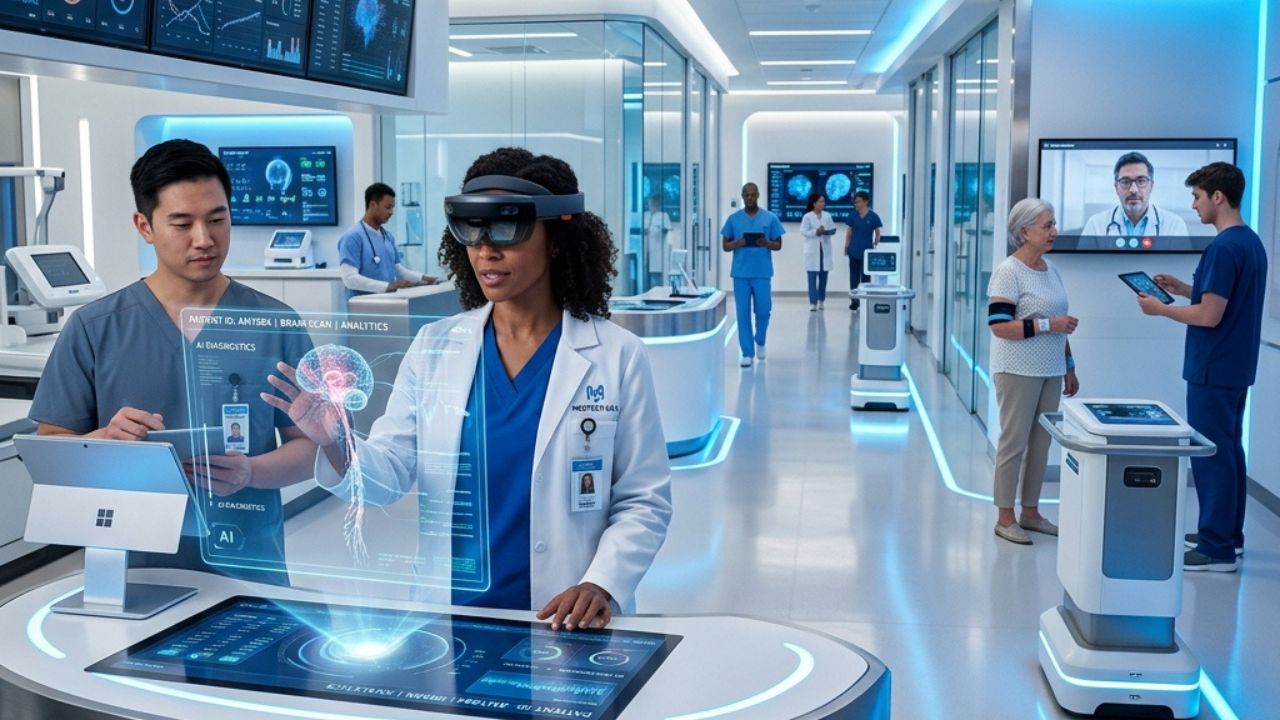
Digital hospitals integrate AI, telemedicine, IoT, and VR/AR to transform how Americans receive and experience healthcare. These technology-driven facilities improve access, reduce costs, and deliver better patient outcomes—but face real hurdles around data security, regulation, and equitable access before they can reach their full potential.
American healthcare is at an inflection point. Hospitals across the country are no longer just buildings with beds and equipment—they are becoming intelligent, connected ecosystems designed to anticipate patient needs, streamline clinical workflows, and deliver care that extends far beyond the hospital walls. This shift toward “digital hospitals” represents one of the most significant transformations in modern medicine.
So what exactly is a digital hospital? At its core, a digital hospital is a healthcare facility that uses interconnected technology—artificial intelligence, cloud computing, the Internet of Things (IoT), telemedicine, and immersive technologies like virtual and augmented reality—to optimize every aspect of patient care and hospital operations. The goal is straightforward: better outcomes, faster decisions, and a more seamless experience for both patients and providers.
The current landscape in America reflects a healthcare system in active transition. According to the American Hospital Association, more than 76% of U.S. hospitals now connect with patients through telehealth platforms. Electronic health records (EHRs) are nearly universal. And major health systems, from Mayo Clinic to Cleveland Clinic, are investing heavily in AI-powered diagnostics and predictive analytics. Still, the full vision of the digital hospital—deeply integrated, data-driven, and universally accessible—remains a work in progress.
This post explores the core technologies shaping that vision, the tangible benefits already being realized, the challenges that must be overcome, and what the next decade of digital healthcare could look like for Americans.
What Core Technologies Are Powering Digital Hospitals?
How is AI being used in hospitals today?
Artificial intelligence is rapidly becoming the backbone of digital hospital operations. Clinical AI tools now assist physicians in reading medical imaging, with platforms like Google Health’s AI model demonstrating diagnostic accuracy comparable to specialist radiologists in detecting breast cancer. Predictive analytics tools flag patients at risk of sepsis or cardiac arrest hours before symptoms escalate. Administrative AI handles scheduling, billing, and documentation—freeing clinical staff to focus on direct patient care.
AI-powered clinical decision support systems are perhaps the most consequential development. These systems analyze patient history, lab results, and real-time vitals to surface treatment recommendations, helping reduce diagnostic errors—a problem the National Academy of Medicine estimates affects approximately 12 million Americans each year.
What role does telemedicine play in digital healthcare delivery?
Telemedicine—remote consultation via video, phone, or messaging platforms—has grown from a niche convenience to a mainstream channel of care. The COVID-19 pandemic accelerated this dramatically: the Centers for Disease Control and Prevention (CDC) reported a 154% increase in telehealth visits during the final week of March 2020 compared to the same period in 2019.
Even beyond the pandemic, telehealth has maintained strong adoption. Patients in rural areas, individuals with mobility limitations, and those managing chronic conditions benefit enormously from the ability to consult physicians without traveling. Digital hospitals are building telehealth directly into care pathways—integrating it with EHRs, remote monitoring devices, and follow-up protocols.
How is the Internet of Things changing patient monitoring?
IoT in healthcare refers to the network of connected medical devices that collect and transmit patient data in real time. Wearable monitors track heart rate, oxygen saturation, and glucose levels continuously. Smart infusion pumps alert nurses to potential dosing errors. Sensor-equipped hospital beds detect patient movement and reduce fall risk.
The practical impact is significant. Remote patient monitoring (RPM) programs—where patients at home transmit health data directly to their care team—have shown measurable results. A study published in the Journal of Medical Internet Research found that RPM interventions reduced hospital readmissions by up to 76% for certain chronic disease populations.
What are VR and AR being used for in hospitals?
Virtual reality (VR) and augmented reality (AR) are carving out genuine clinical applications, moving well past novelty. VR is used in pain management (with research from Cedars-Sinai showing VR reduced pain scores by 24% compared to standard-of-care TV), surgical training, and mental health treatment, particularly for phobias and post-traumatic stress disorder. AR assists surgeons by overlaying anatomical data onto their field of vision during complex procedures, improving precision and reducing risk.
What Are the Key Benefits of Digital Hospitals?
Improved access to care for underserved communities
One of the most compelling arguments for digital hospitals is their potential to reach Americans who currently fall through the cracks. Rural communities, where hospital closures have been accelerating—more than 140 rural hospitals have closed since 2010, according to the Chartis Center for Rural Health—stand to benefit substantially from telehealth and mobile health solutions. Digital infrastructure can extend specialist care into areas where it simply doesn’t exist in physical form.
Greater efficiency and reduced administrative burden
Clinician burnout is a well-documented crisis in American healthcare. Much of it stems from administrative workload—documentation, prior authorizations, and billing consume an estimated 34% of a physician’s workday, according to research published in Health Affairs. AI-driven automation directly addresses this problem. When physicians spend less time on paperwork, they have more time for patients—and they’re more likely to stay in the profession.
Better patient outcomes through data-driven care
Digital hospitals generate and act on vast amounts of clinical data. Predictive models identify high-risk patients earlier. Personalized care plans adapt based on real-time health signals. Medication adherence tracking reduces preventable complications. These capabilities collectively shift care from reactive to proactive—treating problems before they become emergencies.
Cost reduction across the healthcare system
American healthcare spending reached $4.5 trillion in 2022, according to the Centers for Medicare & Medicaid Services. Digital hospital technologies offer meaningful cost reduction pathways: fewer unnecessary hospitalizations, earlier interventions, shorter lengths of stay, and reduced administrative overhead. Telehealth alone has demonstrated cost savings—a 2023 RAND Corporation study found that telehealth visits for low-acuity conditions cost significantly less than equivalent in-person visits.
What Challenges Are Holding Digital Hospitals Back?
How serious is the data security risk in digital healthcare?
Healthcare organizations are among the most frequently targeted by cybercriminals. The HHS Office for Civil Rights reported that in 2023, healthcare data breaches affected more than 133 million Americans—a record high. As hospitals collect more data across more connected devices, the attack surface expands. A breach doesn’t just compromise privacy; it can disrupt clinical operations entirely, as demonstrated by the 2020 ransomware attack on Universal Health Services, which affected operations across 400 facilities.
Robust cybersecurity infrastructure, staff training, and regulatory compliance aren’t optional in a digital hospital—they’re existential requirements.
What regulatory hurdles do digital hospitals face?
Healthcare regulation in the United States is complex and, in many areas, hasn’t kept pace with technological change. Reimbursement frameworks for telehealth services—temporarily expanded during the COVID-19 public health emergency—remain uncertain in a post-emergency landscape. FDA approval pathways for AI-based clinical decision tools are still evolving. Interoperability standards, which determine how different digital systems share data, are improving under the 21st Century Cures Act but remain inconsistent in practice.
Regulatory clarity is essential for hospitals to invest confidently in digital infrastructure.
Who gets left behind in the digital hospital transition?
The “digital divide”—the gap between those with reliable internet access and digital literacy and those without—is a genuine equity concern. Approximately 19 million Americans still lack access to broadband internet, according to the Federal Communications Commission (FCC). Older adults and low-income populations are disproportionately represented in this group. A digital hospital that can’t reach these populations doesn’t solve the access problem—it shifts it.
How expensive is it to implement digital hospital infrastructure?
Digital transformation at scale requires significant upfront investment. EHR systems, cybersecurity infrastructure, AI platforms, and workforce training all carry substantial costs. Smaller community hospitals and federally qualified health centers—which serve disproportionately vulnerable populations—often lack the capital to make these investments independently. Without targeted funding and policy support, digital healthcare risks becoming a resource available primarily to well-funded health systems.
Which Hospitals Are Leading the Way?
Several U.S. health systems offer instructive examples of digital hospital implementation in practice.
Cleveland Clinic has built a comprehensive digital health strategy centered on its Careview program, which uses AI to monitor ICU patients continuously and alert clinicians to deteriorating conditions—improving outcomes in critical care settings.
Mayo Clinic has partnered with Google Cloud to develop AI models for early disease detection, focusing initially on conditions like pancreatic cancer, where early identification dramatically improves survival rates.
Intermountain Health has deployed large-scale telehealth infrastructure across its network, enabling specialist consultations to reach patients in rural Utah and surrounding states—reducing the need for long-distance travel for routine and follow-up care.
These cases share a common thread: digital tools work best when integrated thoughtfully into clinical workflows, with physician buy-in and ongoing evaluation of outcomes.
What Does the Future of Digital Hospitals Look Like?
The next decade of digital healthcare in America will likely be defined by a few key developments. Ambient clinical intelligence—AI that listens to physician-patient conversations and auto-generates documentation—will further reduce administrative burden. Genomic data integration will make personalized medicine increasingly standard. Digital twins (virtual patient models that simulate treatment responses) could transform how physicians plan complex interventions.
At the infrastructure level, 5G connectivity will expand remote monitoring capabilities, enabling more data to be transmitted with lower latency. Edge computing will allow more data processing to happen on-device, improving speed and reducing privacy risk. And as AI models become more transparent and explainable, clinical trust in AI recommendations will grow.
Perhaps most importantly, the definition of a “hospital” will continue to blur. Care will increasingly be delivered at home, in community settings, and through mobile platforms—with the digital hospital functioning as a coordination hub rather than the sole site of treatment.
The Path Forward for Stakeholders in American Healthcare
Digital hospitals represent a fundamental reimagining of how care is delivered, organized, and experienced. The technologies are real, the benefits are documented, and the momentum is building. But the transition requires deliberate action from every stakeholder in the healthcare system.
Hospital administrators need to prioritize interoperability and staff training alongside technology procurement. Policymakers need to establish durable reimbursement frameworks and close the digital divide. Clinicians need to engage in the design of digital tools, not just their deployment. And patients need access to the education and connectivity that allows them to participate fully in digital care models.
The future of American healthcare won’t be built in a single transformation—it will be assembled piece by piece, system by system, patient by patient. The digital hospital is the architecture that makes it possible.
Frequently Asked Questions
What is a digital hospital?
A digital hospital is a healthcare facility that integrates technologies such as AI, telemedicine, IoT devices, and electronic health records to improve patient care, streamline clinical operations, and extend healthcare access beyond traditional hospital settings.
How does AI improve patient safety in hospitals?
AI improves patient safety by analyzing real-time clinical data to detect early warning signs of deterioration, flagging potential medication errors, and supporting physicians with evidence-based diagnostic recommendations—reducing the likelihood of adverse events.
Is telemedicine as effective as in-person care?
For many conditions—particularly low-acuity illnesses, mental health consultations, and chronic disease management—telemedicine has demonstrated comparable effectiveness to in-person care. It is not a universal substitute for hands-on physical examination, but it is an effective complement for a broad range of clinical scenarios.
What is the biggest barrier to digital hospital adoption in America?
The barriers vary by institution, but cost and cybersecurity are consistently cited as top challenges. Smaller hospitals often lack capital for digital infrastructure, while all hospitals face growing risks from cyberattacks targeting healthcare data.
How do digital hospitals address health equity?
When implemented with equity as a design principle—including broadband access initiatives, multilingual interfaces, and outreach to underserved communities—digital hospitals can expand care to populations historically underserved by the traditional healthcare system. Without intentional design, however, they risk exacerbating existing disparities.
What emerging technologies will shape digital hospitals in the next decade?
Key emerging technologies include ambient clinical intelligence (AI-assisted documentation), genomic medicine integration, digital twin modeling for personalized treatment planning, 5G-enabled remote monitoring, and increasingly sophisticated predictive analytics platforms