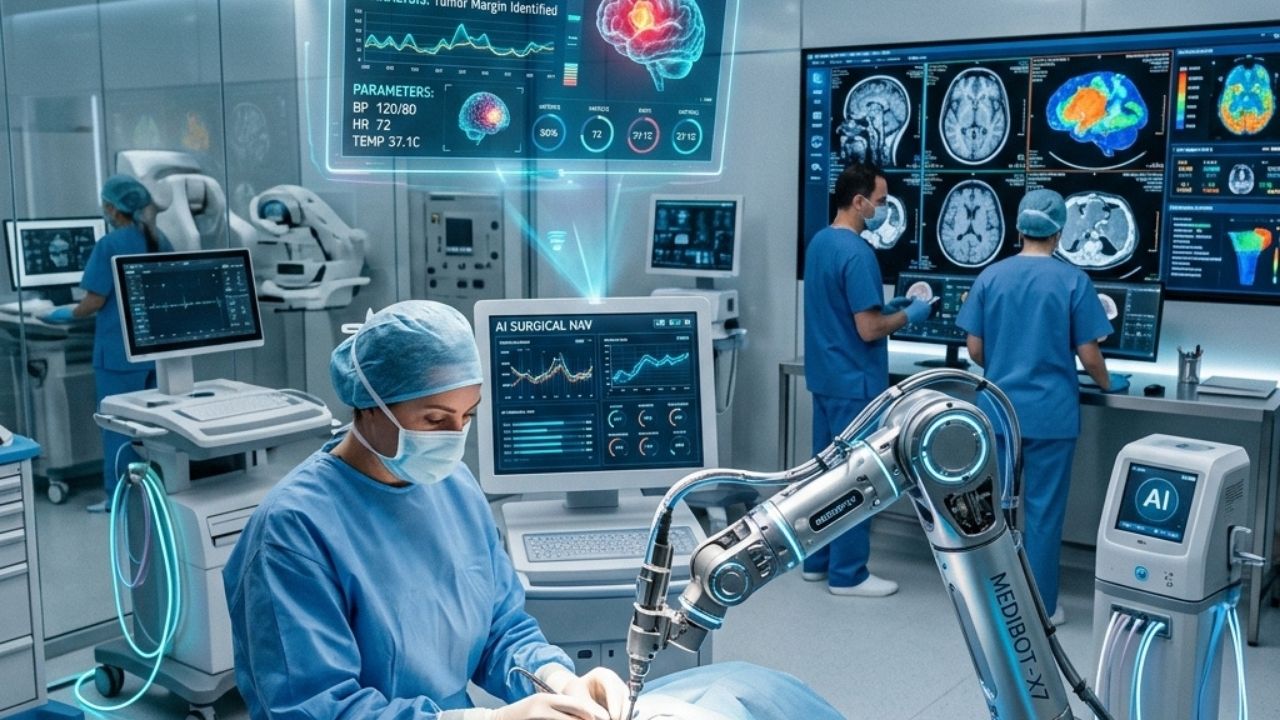
American healthcare is being reshaped by three technologies—artificial intelligence, robotics, and personalized medicine. AI sharpens disease detection, robots make surgery more precise, and genetic insights tailor treatments to individual patients. Together, they promise faster diagnoses, better outcomes, and care built around the person rather than the average.
Something big is happening in hospitals and clinics across the United States. A radiologist reviews a scan flagged by an algorithm. A surgeon guides a robotic arm through an incision smaller than a fingertip. A cancer patient receives a drug chosen because of a specific mutation in their tumor. None of this was routine a decade ago.
Healthcare is shifting from a one-size-fits-all model toward something faster, smarter, and far more personal. Artificial intelligence, robotics, and personalized medicine sit at the heart of that change. Each is powerful on its own. Combined, they’re rewriting how doctors diagnose disease, plan treatment, and predict who might get sick in the first place.
This post breaks down what these three technologies actually do, where they’re already making a difference, and the hard questions they raise. Whether you’re a clinician, a patient, or simply someone trying to understand where medicine is headed, you’ll come away with a clearer picture of the road ahead.
How is AI changing medical diagnosis and treatment?
Artificial intelligence has moved from research labs into real clinical workflows, and diagnostics is where its impact shows most clearly. Machine learning models are trained on enormous volumes of medical data—images, lab results, patient histories—and they learn to spot patterns that are easy for the human eye to miss.
Detecting disease earlier and more accurately
Cancer and heart disease are two areas where AI is proving its worth. Algorithms can scan mammograms, CT scans, and pathology slides to flag suspicious areas, giving physicians a valuable second set of eyes. Early detection matters enormously here. A tumor caught at stage one is far more treatable than one found at stage three.
The strength of these tools lies in consistency. A human radiologist might review hundreds of images in a day, and fatigue creeps in. An algorithm applies the same level of scrutiny to the first scan and the five-hundredth. That reliability, paired with a trained clinician’s judgment, can lift detection rates for conditions that are easy to overlook.
Speeding up imaging analysis
AI-powered imaging tools do more than improve accuracy—they save time. Analyzing a complex scan can take a specialist several minutes of careful review. AI systems can pre-process those images in seconds, highlighting regions that deserve a closer look. That means faster answers for patients and more time for doctors to focus on complex cases.
One well-known example is IBM Watson for Oncology, an early attempt to use AI to recommend cancer treatments by analyzing patient data against a vast library of medical literature. Radiology AI systems have followed, with tools designed to improve detection rates for conditions ranging from lung nodules to diabetic eye disease. These systems don’t replace physicians. They support them.
The limits and ethics of AI in medicine
For all the promise, AI in healthcare comes with real limitations. Algorithms are only as good as the data they learn from. If a training dataset underrepresents certain populations, the resulting tool may perform poorly for those groups—a serious concern in a country as diverse as the United States. Bias baked into data becomes bias in diagnosis.
There are questions of accountability, too. If an algorithm misses a tumor, who’s responsible—the doctor, the hospital, or the company that built the software? Patient privacy adds another layer of concern, since these systems depend on access to sensitive health records. Transparency is the sticking point. Many models function as “black boxes,” offering conclusions without clear reasoning, which makes clinicians understandably cautious about trusting them blindly.
What role do robots play in modern surgery and care?
Robotics has quietly become one of the most tangible technologies in American hospitals. When people picture medical robots, they often imagine autonomous machines making decisions. The reality is more collaborative—robots extend a surgeon’s abilities rather than replace their hands.
Precision surgery with robotic assistance
Robotic surgical systems allow surgeons to operate through tiny incisions with tools that bend and rotate beyond the range of the human wrist. The surgeon controls every movement from a console, while the system filters out tremors and translates broad hand motions into fine, steady actions.
The payoff for patients is significant. Smaller incisions mean less blood loss, lower infection risk, and shorter hospital stays. Procedures that once required large openings and weeks of recovery can now be done with a few small cuts. For operations in tight, delicate spaces—like the prostate or the heart—that added precision can be the difference between a good outcome and a complication.
Robots beyond the operating room
Surgery grabs the headlines, but robotics reaches further into everyday care. Automated systems in hospital pharmacies dispense and package medications, cutting the risk of human error. Disinfection robots use ultraviolet light to sanitize rooms between patients, an especially valuable role in the wake of the COVID-19 pandemic. Some facilities use mobile robots to ferry supplies and lab samples through corridors, freeing staff to spend more time with patients.
Rehabilitation is another frontier. Robotic exoskeletons help patients relearn how to walk after strokes or spinal injuries, providing steady support and precise repetition that would exhaust a human therapist. These machines don’t heal on their own, but they multiply what care teams can accomplish.
How does personalized medicine tailor treatment to each patient?
For most of medical history, treatment has been built around averages. A drug approved because it worked for the majority in a clinical trial gets prescribed to everyone with the same diagnosis. Personalized medicine flips that logic, using a patient’s unique biology to guide decisions.
Treatment guided by genetics
The falling cost of genetic sequencing has opened the door to care shaped by an individual’s DNA. In oncology, doctors can analyze the genetic makeup of a tumor and match it to therapies designed to target specific mutations. Instead of subjecting every patient to the same chemotherapy, physicians can choose drugs more likely to work and less likely to cause needless side effects.
This approach extends beyond cancer. Pharmacogenomics—the study of how genes affect a person’s response to drugs—helps predict which medications will be effective and at what dose. Two patients with identical symptoms may process the same drug in very different ways. Knowing that in advance spares people the trial-and-error cycle that has long frustrated both patients and doctors.
Predicting risk before disease strikes
Personalized medicine isn’t only about treating illness—it’s about getting ahead of it. By combining genetic data with lifestyle and environmental factors, doctors can identify patients at high risk for conditions like heart disease or certain cancers well before symptoms appear. That knowledge opens the door to earlier screening, targeted prevention, and lifestyle changes that can alter a person’s trajectory.
The three technologies reinforce one another here. AI sifts through the mountains of genetic and clinical data that personalized medicine generates, spotting patterns no human could catch. The result is a feedback loop where each advance sharpens the others.
What are the biggest challenges facing this healthcare shift?
The promise is real, but so are the obstacles. Cost sits at the top of the list. Robotic surgical systems, AI software, and genetic testing all carry steep price tags, raising a difficult question about access. If these tools cluster in well-funded urban hospitals, they risk widening the gap between the care available to wealthy patients and everyone else.
Regulation is still catching up. Approving a static drug is one thing; overseeing an AI system that learns and changes over time is another entirely. Regulators face the tricky task of ensuring these tools are safe without smothering the innovation that makes them valuable.
Then there’s trust. Patients and providers alike need confidence that a recommendation from an algorithm or a robot is sound. Building that trust takes transparency, strong evidence, and a clear understanding that technology supports human judgment rather than overriding it. The goal isn’t to remove doctors from the equation—it’s to give them sharper tools.
Where American healthcare goes from here
The convergence of AI, robotics, and personalized medicine marks a genuine turning point for American healthcare. Diagnoses are becoming faster and more accurate. Surgeries are growing less invasive. Treatments are increasingly built around the individual instead of the average. These aren’t distant predictions—they’re changes already underway in hospitals across the country.
The path forward depends on getting the human elements right: fair access, thoughtful regulation, and hard-earned trust. Technology can flag the tumor, steady the scalpel, and read the genome, but people still decide how to use those insights with care and compassion.
If you’re a healthcare professional, now is the time to learn how these tools fit your practice. If you’re a patient, ask your providers how AI, robotics, or genetic testing might shape your care. And if you’re a policymaker, the decisions made today about access and oversight will echo for decades. Staying informed is the first step toward shaping a healthcare system that works better for everyone.
Frequently asked questions
Will AI replace doctors in the future?
No. AI is designed to support clinicians, not replace them. It excels at spotting patterns in data and speeding up tasks like image analysis, but it lacks the judgment, empathy, and contextual understanding that physicians bring. The most effective model pairs AI’s processing power with a doctor’s expertise.
Is robotic surgery safer than traditional surgery?
For many procedures, robotic surgery offers real advantages—smaller incisions, less blood loss, lower infection risk, and faster recovery. That said, it isn’t the right choice for every operation, and outcomes still depend heavily on the surgeon’s skill. The best approach varies by procedure and patient.
How much does personalized medicine cost patients?
Costs vary widely depending on the test or treatment. Genetic sequencing has become far cheaper than it once was, but targeted therapies and specialized testing can still be expensive. Insurance coverage differs by plan and condition, so patients should confirm what’s covered before proceeding.
Who benefits most from these healthcare technologies?
Patients facing complex conditions like cancer or heart disease often see the greatest benefit, since AI diagnostics, robotic surgery, and genetic-guided treatment shine in high-stakes cases. Over time, as costs fall and access widens, these tools are expected to reach a much broader range of patients.